The congiuntivo marks a stance, not a time
Treccani defines the congiuntivo as a finite mood with four tenses: presente, imperfetto, passato, and trapassato. The name means "that joins", because most of the time it links a subordinate clause to a main one. In many of those clauses it competes with the indicative, and the choice signals a shade of wish, possibility, or doubt. Compare So che Marco è a casa with Penso che Marco sia a casa. Both are about the same fact. The first states it, and the second presents it as the speaker's opinion.
A quick sorting test works for most sentences. Look at the verb before che. Verbs of certainty and reporting, such as sapere, dire, scrivere, and phrases like è vero che or è chiaro che, keep the indicative. Verbs and phrases of emotion, desire, opinion, and doubt, such as sperare, volere, pensare, dubitare, or è importante che, call for the congiuntivo. One more filter comes first: if both clauses share a subject, Italian uses an infinitive, not che. Voglio uscire is "I want to go out", while Voglio che tu esca is "I want you to go out". The Spanish subjunctive page describes the same subject-change trigger.
Present forms: six persons, four written forms
For -are verbs the present takes -i, -i, -i, -iamo, -iate, -ino, so parlare gives parli, parli, parli, parliamo, parliate, parlino. For -ere and -ire verbs the endings start with a: metta, metta, metta, mettiamo, mettiate, mettano and dorma, dorma, dorma, dormiamo, dormiate, dormano. The vowels feel backwards to many learners, since -are verbs get i and the other two classes get a. Verbs that insert -isc- in the indicative keep it here for the singular and the loro form (capisca, capiscano) but not for noi and voi (capiamo, capiate).
Counting the written forms shows the practical problem. Six person slots collapse into four distinct forms, because io, tu, and lui/lei are spelled identically. That is why Italians usually say the pronoun after che: Credo che tu parli bene, not just Credo che parli bene, which leaves the speaker unclear. The noi form also matches the present indicative (parliamo), so the trigger before che is the only clue to the mood there. Spelling holds steady too: -care and -gare verbs keep their hard sound with an h, giving cerchi and paghi, the same adjustment you see in the Italian future tense.
Many irregular present forms echo the verb's own irregular indicative. Common io forms are vada (andare), abbia (avere), dia (dare), dica (dire), debba (dovere), sia (essere), faccia (fare), possa (potere), rimanga (rimanere), sappia (sapere), stia (stare), tenga (tenere), esca (uscire), venga (venire), and voglia (volere).
Imperfect, passato, trapassato: built from what you already know
The imperfetto uses one ending family per class: parlassi, parlassi, parlasse, parlassimo, parlaste, parlassero, then mettessi... and dormissi..., with capissi... for -isc- verbs. That is five distinct forms for six persons, since only io and tu coincide. Most of the irregulars are verbs that are already irregular in the indicative imperfect: fossi (essere), facessi (fare), bevessi (bere), dicessi (dire). Stare, which is regular there, also has its own imperfetto stem (stessero). Once you know fossi and avessi, you can build the last two tenses.
The passato takes avere or essere in the present congiuntivo plus the past participle: abbia ricevuto, sia andato, siate partiti. The trapassato takes the imperfect congiuntivo of the same auxiliary plus the participle: avessi ascoltato, fossi arrivato, fossimo usciti. Participle agreement and the choice of avere or essere follow the passato prossimo rules unchanged.
Choosing the tense: a two-question grid
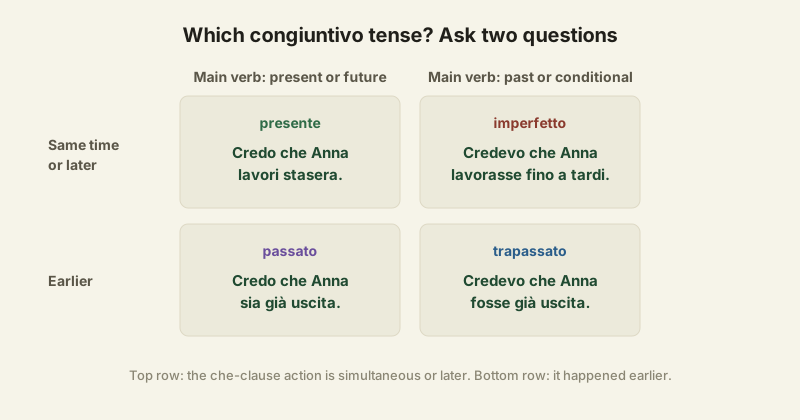
The tense follows two questions. Is the main verb in the present or future, or in a past tense or the conditional? And did the action in the che clause happen at the same time as or after the main verb, or before it? The four answers give four tenses. Present or future main verb, same time or later: presente (Credo che Anna lavori stasera). Present main verb, earlier action: passato (Credo che Anna sia già uscita). Past or conditional main verb, same time or later: imperfetto (Credevo che Anna lavorasse fino a tardi). Past main verb, earlier action: trapassato (Credevo che Anna fosse già uscita). This grid is a summary of the sequencing rule (the consecutio temporum) that university grammars such as UNC's describe.
Two wrinkles to know. After a present-tense main verb, the present congiuntivo is not the only way to look ahead: Penso che Marco parta domani and Penso che Marco partirà domani are both taught as correct. And the imperfetto can follow a present-tense main verb when the action was habitual or ongoing in the past, as in È un peccato che piovesse ogni volta che uscivamo.
Triggers beyond che-clauses, and the conjunctions that demand it
Some conjunctions require the congiuntivo on their own: benché and sebbene (although), affinché (so that), prima che (before), senza che (without), a meno che (unless), and purché (provided that). Verbs in the negative, such as non credo, non penso, and non so, trigger it as well: Non credo che Luisa abbia ragione. Treccani adds that in some subordinate clauses the congiuntivo is preferred to the indicative for reasons of register, meaning a higher register, and that a few clause types allow it as the only explicit mood.
Relative clauses pull it in too. UNC lists three cases, and the examples here are my own: after a superlative (È il film più lungo che io abbia visto), after a negative (Non c'è nessuno che sappia la risposta), and after an indefinite (Cerco qualcuno che parli russo). Watch perché too. With the sense "so that" it triggers the mood, and with the sense "because" it does not.
The congiuntivo also stands alone. Treccani sorts these uses into four types: the exhortative (Nessuno si muova!), the dubitative (Che sia già partito?), the desiderative (Potessi dormire un'ora in più!), and the exclamative (Magari fosse domenica!). For wishes, the imperfetto points at the present or future, while the trapassato points at the past: Fossi stata più attenta!
The same two tenses also power the hypothetical se clause. Treccani says the imperfetto or trapassato appears in the protasis of second- and third-type hypothetical sentences, for a situation that is possible but unlikely, or impossible. Se avessi più tempo, imparerei il russo pairs the imperfetto with a present conditional. Se avessi preso il treno delle otto, ora sarei già a casa uses the trapassato for a condition that is now past.
What counts as an error, per Treccani
Treccani lists a few forms that sound natural and are still marked wrong. The pull of the -are class is strong enough that venghi and venghino turn up, and Treccani calls them incorrect today, though sometimes used ironically. The old singular forms sii, abbi, sappi, vogli are no longer correct as congiuntivo forms and now serve as imperatives. Another one is the imperfetto standing in for an exhortative present, as in Stesse attento. Treccani flags it as incorrect, even though it is increasingly common in speech and informal writing, and it originally belonged to central-southern speech. This section rests on Treccani alone, without a second normative source.