Why one English word hides two Spanish prepositions
English collapses a lot of ground into the single word "for": this gift is for you, I studied for two hours, thanks for the help, we left for Madrid. Spanish keeps two separate prepositions for that ground, and they are not interchangeable. Using the wrong one is a genuine grammar error, not a stylistic slip, and Spanish speakers notice it immediately.
The reason English speakers default to translating word-for-word is that "for" does not map cleanly onto either por or para on its own. The fix is to stop translating and start asking what role the phrase is playing: is it pointing at a goal, or is it pointing at a cause? Para points forward, at where something is headed. Por points backward or sideways, at why or how or through what something happens. Spanish draws a comparably sharp, easy-to-miss line among its own small connecting words, too: Spanish conjunctions covers why pero and sino aren't interchangeable translations of "but," a distinction English collapses into one word the same way it collapses por and para into "for."
Para: purpose, destination, deadline, recipient
Para answers "what for?" or "where to?" It always has a target. Four uses cover almost everything you will see:
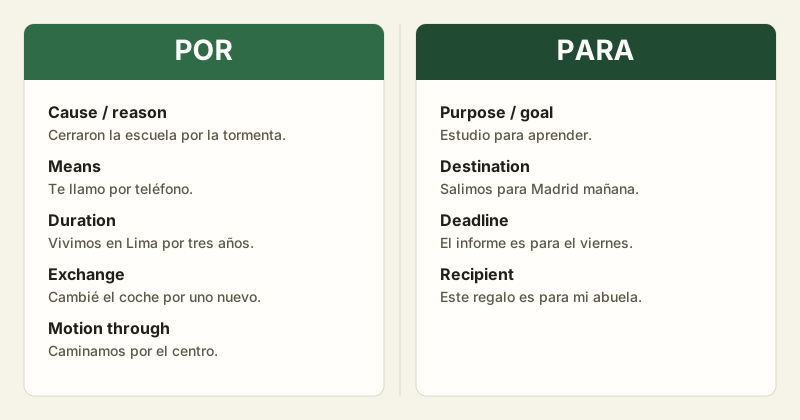
Purpose or goal. Estudio español para viajar a Chile el próximo año. (I study Spanish in order to travel to Chile next year.) If you can rephrase the sentence with "in order to," it is para.
Destination. Salimos para Madrid mañana. (We're leaving for Madrid tomorrow.) The endpoint of the trip, not the road you take to get there.
Deadline. El informe es para el viernes. (The report is due by Friday.) A point in the future the action is aimed at, not a stretch of time it fills.
Recipient. Este regalo es para mi abuela. (This gift is for my grandmother.) Who the thing is ultimately meant for.
Por: cause, means, duration, exchange, motion through
Por answers "why?" or "how?" or "through what?" It points at an origin, a method, or a path, not a destination.
Cause or reason. Cerraron la escuela por la tormenta. (They closed the school because of the storm.) This is the one learners get wrong most often in the other direction: gracias por tu ayuda ("thanks for your help") uses por, not para, because the help is the reason for the thanks, not its destination.
Means. Te llamo por teléfono esta noche. (I'll call you by phone tonight.) The channel something travels through.
Duration. Vivimos en Lima por tres años. (We lived in Lima for three years.) A stretch of time the action fills, not a deadline it's aimed at (compare this to el informe es para el viernes above).
Exchange. Cambié mi coche viejo por uno nuevo. (I traded my old car for a new one.) Money or goods changing hands, one thing standing in for another.
Motion through a place. Caminamos por el centro histórico. (We walked through the historic center.) Contrast this with para's destination sense: caminamos para el centro would mean walking toward downtown as a goal, not wandering through it.
A test that actually works, and the phrases where it breaks
Because the categories above can blur together in a fast conversation, the fastest working test is a rephrasing test, not a translation test: if you can substitute "in order to," "for the purpose of," or "by [deadline]" and the sentence still makes sense, it's para. If you can substitute "because of," "by means of," "through," or "in exchange for," it's por.
A handful of set phrases don't map onto either category cleanly and are just worth memorizing directly: por fin (finally), por supuesto (of course), por ejemplo (for example), and para siempre (forever) are fixed expressions where the preposition is baked into the idiom rather than derived from the rule.
Por and para aren't the only pair of Spanish words that collapse into one option in English: ser and estar both translate as "to be," and the logic for telling them apart works the same way this one does. Stop translating, and ask what job the word is doing in the sentence.
"Estar para" and "estar por": one more place they split
The two prepositions split again when they pair with estar, and here the two phrases genuinely overlap rather than sitting in clean, separate categories. Estar para + infinitive most often signals readiness or mood: No estoy para chistes ("I'm not in the mood for jokes") uses it to describe a state of mind, and the same construction can describe something poised and ready to happen. Estar por + infinitive leans toward intention or something expected in the near future, closer to "about to" or "still to be done."
Both phrases can genuinely mean "about to" depending on the region, which makes this one of the few spots where the clean por/para logic above gives way to dialect variation: some Spanish-speaking regions favor estar por for "about to," others reach for estar para in the same situation. Unlike the core rule, this is a case where listening to how the people around you actually talk is more reliable than applying a fixed rule.